


Dark pools are private trading venues where institutional investors execute large orders without revealing their transactions to the public. These alternative trading systems (ATS) have been a part of traditional finance since the 1980s, providing a means to mitigate market impact when executing substantial trades.
In public exchanges like the New York Stock Exchange (NYSE) or NASDAQ, large buy or sell orders can significantly shift market prices due to increased visibility. For example, if an institutional investor wants to purchase 1 million shares of a stock, publicly placing this order could cause the stock’s price to rise, making the trade more expensive. To avoid such price fluctuations, dark pools allow these large trades to occur away from the public eye.
While dark pools offer benefits such as reduced market impact and better execution prices, they also raise concerns about transparency and potential market manipulation. Regulators like the U.S. Securities and Exchange Commission (SEC) monitor traditional dark pools to prevent unfair advantages and conflicts of interest.
How Dark Pools Operate in Crypto Trading
Dark pools have made their way into the crypto market, offering similar benefits to large-scale investors. In cryptocurrency trading, dark pools function as off-chain liquidity venues where high-net-worth individuals, hedge funds, and institutional investors can execute trades without affecting public order books.
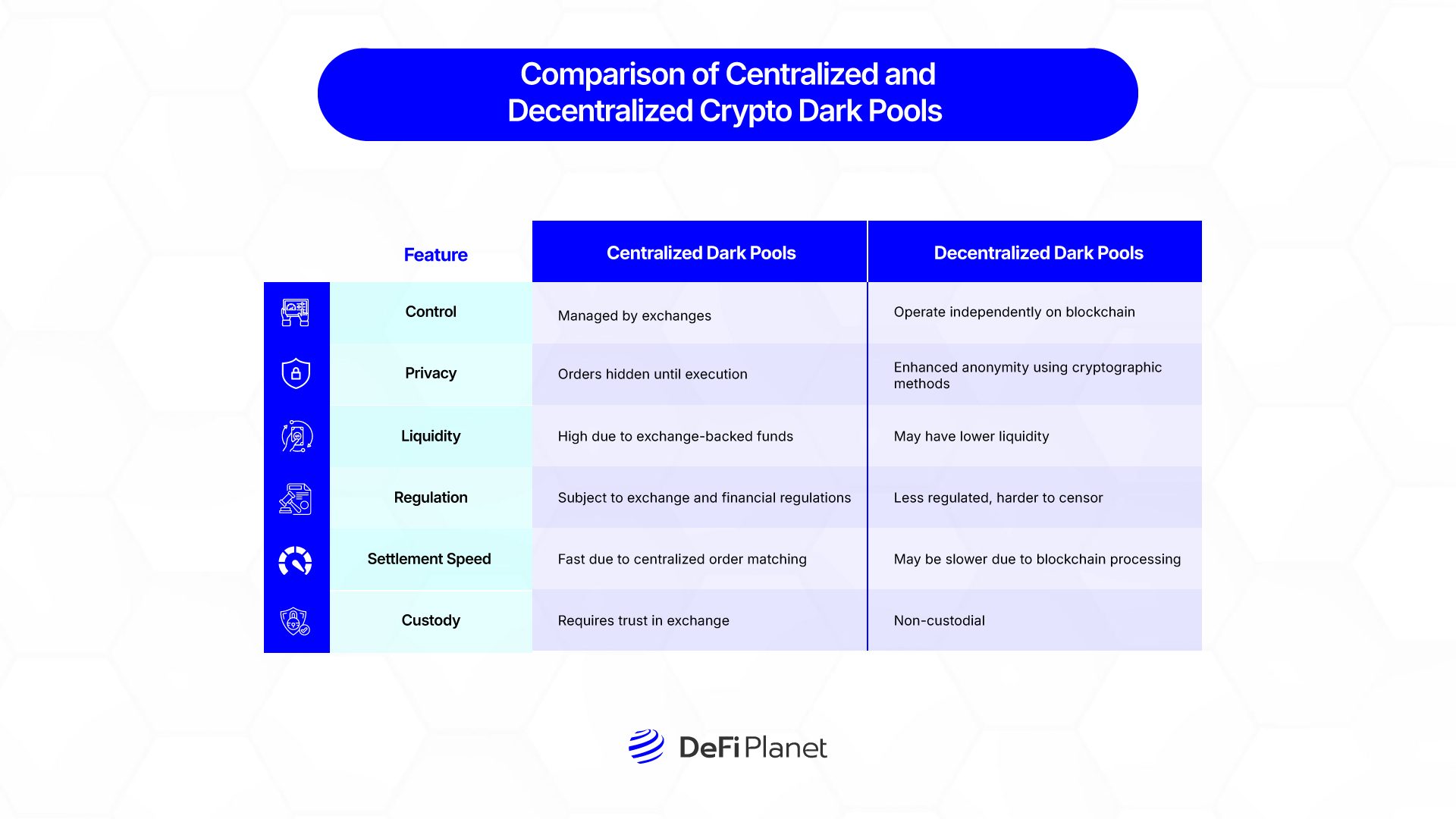
Crypto dark pools cater specifically to large-scale digital asset traders who seek privacy, minimal price slippage, and reduced market impact. These pools are classified into two main types: Centralized Dark Pools and Decentralized Dark Pools.
1. Centralized Crypto Dark Pools
Centralized dark pools operate as a private trading feature within established cryptocurrency exchanges. These platforms provide institutional and high-net-worth traders with an option to execute large transactions without exposing them to the public order book. Instead of routing orders through the open market, traders can seamlessly switch to a dark pool for discreet execution.
Key Features:
- Integrated within centralized exchanges like Binance, Coinbase, or Kraken.
- Orders remain hidden until execution, preventing front-running.
- Faster trade settlements due to exchange-backed liquidity.
- Still subject to exchange regulations and potential counterparty risks.
Examples of Centralized Crypto Dark Pools:
- Kraken Dark Pool – A private trading venue for executing large BTC orders discreetly.
- sFOX Dark Pool – Designed for institutional traders, providing deep liquidity and minimal price slippage.
A significant advantage of centralized dark pools is their enhanced privacy and liquidity. However, traders must trust the exchange to facilitate transactions fairly and securely.
2. Decentralized Crypto Dark Pools
Decentralized dark pools operate independently of centralized exchanges, leveraging blockchain technology and smart contracts to facilitate private trades. Unlike centralized alternatives, these platforms ensure true anonymity and eliminate reliance on intermediaries.
Key Features:
- Operate similarly to decentralized exchanges (DEXs) but focus on institutional-scale trades.
- Utilize cryptographic techniques like multi-party computation (MPC) and zero-knowledge proofs (ZKPs) to execute trades while ensuring anonymity.
- Non-custodial, allowing traders to retain control over their assets.
- More resistant to censorship and regulatory scrutiny.
Examples of Decentralized Crypto Dark Pools:
- Ren (formerly Republic Protocol) – A decentralized dark pool using secure multiparty computation to facilitate private crypto trading.
- Particl – A privacy-focused protocol leveraging ring signatures and confidential transactions for anonymous trading.
Decentralized dark pools provide an extra layer of privacy and security, making them ideal for crypto-native traders who prioritize decentralization. However, they may face challenges such as lower liquidity compared to their centralized counterparts.
Advantages of Crypto Dark Pools
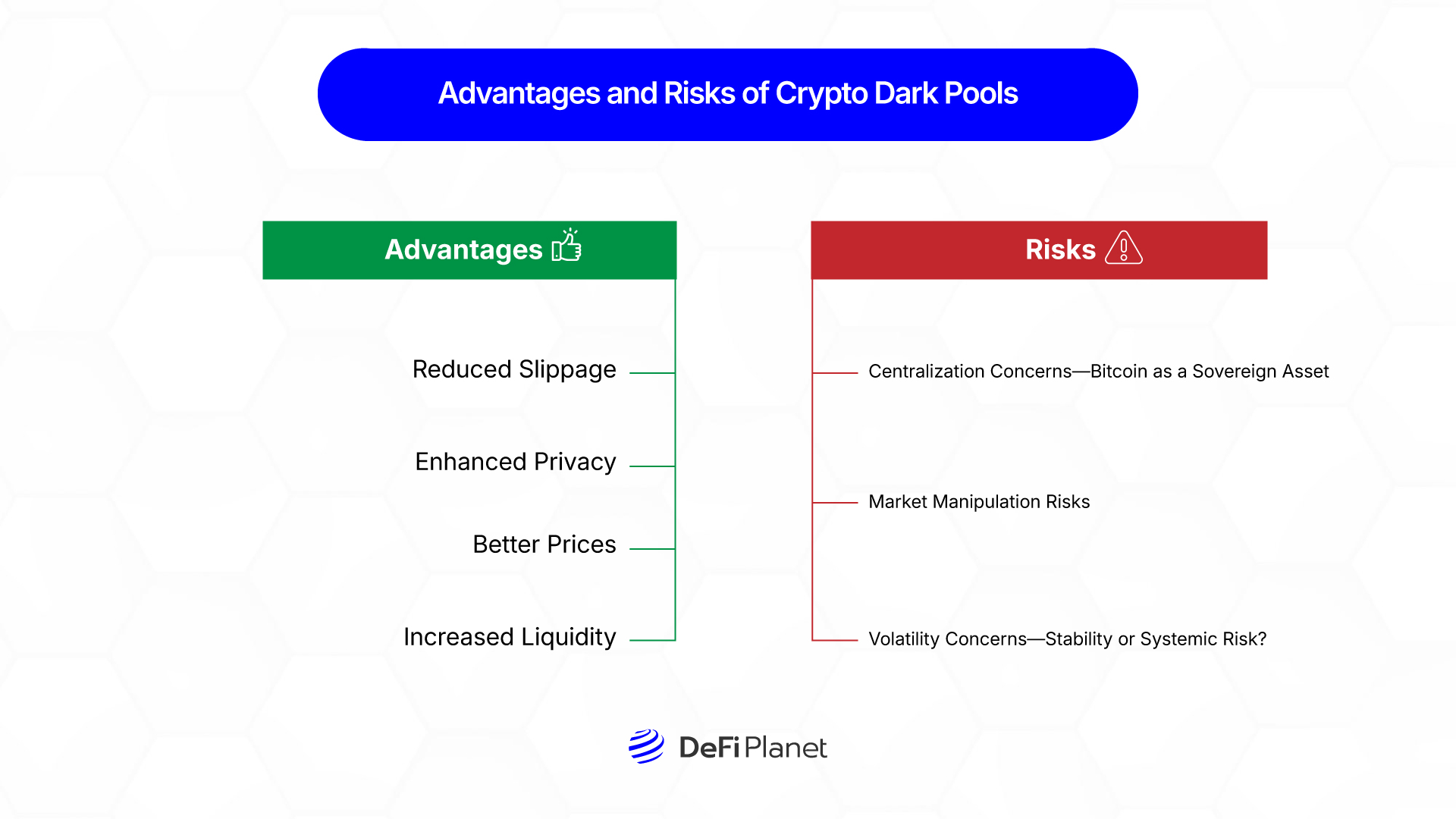
Large cryptocurrency transactions executed on public exchanges often experience price slippage, where the final executed price deviates from the expected price due to market impact. Crypto dark pools minimize this issue by allowing traders to execute large orders at predetermined prices without exposing them to the open market. This ensures that institutional and high-net-worth investors can complete their trades without causing abrupt price fluctuations.
- Enhanced Anonymity and Privacy
One of the key benefits of dark pools is the increased privacy they offer. Trades conducted in dark pools are not publicly visible until after execution, reducing the likelihood of front-running—where other traders take advantage of pre-disclosed trade information to manipulate prices. This anonymity protects institutional traders and high-value investors from market exploitation.
- Improved Execution Prices
Crypto dark pools often aggregate liquidity from multiple sources, allowing for optimal price matching without direct exposure to market volatility. Since trades occur away from public order books, investors can avoid rapid price swings that typically affect large orders, leading to better execution prices compared to traditional exchanges.
- Increased Liquidity for Institutional Traders
Institutional investors and high-frequency traders require deep liquidity to move substantial volumes without negatively impacting market conditions. Crypto dark pools facilitate such trades by providing a private and controlled environment, ensuring seamless execution while maintaining market stability. This increased liquidity benefits the broader cryptocurrency ecosystem by preventing excessive volatility and price disruptions.
Risks of Crypto Dark Pools
- Lack of Market Transparency
Unlike traditional exchanges, where order book data is visible to all participants, dark pools operate with minimal transparency. This means that retail traders have little insight into market depth, liquidity levels, and the volume of ongoing trades. Such opacity can lead to price inefficiencies and create opportunities for manipulation by larger players.
Institutional investors and high-frequency traders operating in dark pools often have access to advanced market insights and sophisticated trading strategies unavailable to retail traders. This creates an imbalance where well-informed traders can take advantage of less-informed participants, leading to potentially unfair trading conditions.
- Regulatory Uncertainty and Legal Risks
Unlike traditional dark pools, which are often regulated by financial authorities in stock markets, crypto dark pools operate in a largely unregulated or loosely regulated space. The evolving nature of cryptocurrency regulations means that traders using dark pools may face legal uncertainties, including potential restrictions, compliance challenges, or sudden regulatory crackdowns.
- Predatory Trading Practices
Some dark pools attract high-frequency traders (HFT) who engage in predatory tactics such as ‘pinging.’ This involves placing small test trades to detect large orders within the dark pool, allowing them to manipulate market movements and capitalize on price shifts. Such practices can lead to unfair advantages and erode the benefits of dark pools for legitimate institutional investors.
In Conclusion
Crypto dark pools are shaping the future of large-scale digital asset trading by offering institutional investors privacy, better trade execution, and reduced market impact. While they provide advantages like enhanced liquidity and price stability, their lack of transparency raises concerns about fairness and regulatory oversight.
As cryptocurrency adoption grows, dark pools will likely play an even greater role in attracting institutional capital to the market. However, traders must remain aware of regulatory changes and potential risks, such as market manipulation and legal uncertainties. Whether dark pools will continue to thrive depends on how the industry balances innovation, security, and compliance.
Disclaimer: This article is intended solely for informational purposes and should not be considered trading or investment advice. Nothing herein should be construed as financial, legal, or tax advice. Trading or investing in cryptocurrencies carries a considerable risk of financial loss. Always conduct due diligence.
If you want to read more market analyses like this one, visit DeFi Planet and follow us on Twitter, LinkedIn, Facebook, Instagram, and CoinMarketCap Community.
Take control of your crypto portfolio with MARKETS PRO, DeFi Planet’s suite of analytics tools.”