


The DeFi lending space has seen rapid growth, but with so many platforms promising improved access, faster transactions, and greater security, it’s difficult to tell which ones will actually deliver long-term value.
One platform generating significant attention is Mutuum Finance, a decentralized solution that leverages blockchain technology to make on-chain credit more accessible, offering a transparent and decentralized alternative to traditional financial systems.
But with bold claims and a highly competitive DeFi space, the question remains: Can Mutuum Finance truly reshape decentralized lending, or is it just another experiment in a rapidly evolving space?
What is Mutuum Finance?
Mutuum Finance is a decentralized lending platform that wants to fix what’s broken in traditional finance. It cuts out banks and middlemen by using blockchain tech, giving people faster, cheaper, and fairer access to credit. You can borrow and lend directly, and everything runs through code (smart contracts), not paperwork.
In a world where getting a loan often depends on your bank or credit score, Mutuum is trying to open things up using Web3 tools, giving people more control over their financial options.
How Mutuum Finance Works
Mutuum Finance blends smart contracts with decentralized credit scoring to create a flexible lending ecosystem. It supports both overcollateralized and trust-based undercollateralized lending, offering options for traditional DeFi users and those with verified real-world identities.
Step-by-Step Lending Process
- Connect Wallet & Establish Trust
Borrowers begin by connecting their crypto wallet to the Mutuum platform. For undercollateralized loans, they undergo a credit evaluation powered by underwriters, trusted partners who assess a borrower’s real-world identity and financial history. This off-chain trust is tokenized into a soulbound token (SBT), permanently tied to the borrower’s wallet.
- Choose Collateral and Loan Terms
Borrowers deposit crypto assets as collateral. Thanks to the trust system, they can access loans with lower collateral requirements than typical DeFi platforms. For standard lending, Mutuum enforces overcollateralization, requiring the value of collateral to exceed the loan amount, based on strict Loan-To-Value (LTV) ratios assigned to each asset.
Once approved, borrowers receive their loan in Mutuum-issued stablecoins, which are minted on-demand and backed by collateral. These stablecoins can be used freely while the borrower’s position remains within safe limits.
- Automated Loan Management
Smart contracts automate the entire lifecycle of the loan, from disbursement to interest calculation to repayment tracking. There are no preset deadlines, and borrowers can repay partially or fully at any time, as long as they maintain the required collateral ratio.
- Risk Monitoring & Liquidation
If the collateral value drops below a certain liquidation threshold, Mutuum’s automated system kicks in. Liquidators can repay part of the borrower’s debt in exchange for collateral at a discount, maintaining the protocol’s solvency. This also applies to multi-asset collateral, where a weighted liquidation threshold is calculated to reflect total risk.
How Lenders Participate
- Provide Liquidity to Dedicated Pools
Lenders deposit assets like ETH, USDT, or DAI into dedicated liquidity pools for each supported crypto. In return, they receive mtTokens (e.g., mtETH, mtDAI) minted at a 1:1 ratio. These mtTokens continuously accumulate value as interest is earned from borrower repayments.
- Earn Interest Based on Risk
Interest rates adjust dynamically based on the utilization rate of the pool and the borrower’s trust rating. Higher risk = higher potential returns. Lenders benefit from flexible, transparent interest accrual without having to manage individual loans.
- mtToken Flexibility & Rewards
mtTokens are ERC-20 compliant, so they can be transferred or traded in secondary DeFi markets. They can also be redeemed at any time for the original asset plus accrued interest. When redeemed, mtTokens are burned, keeping the supply in balance.
Role of $MUTM Token in the Mutuum Finance Ecosystem
The platform’s native token, $MUTM, plays a crucial role by driving user interaction, platform governance, and the broader decentralized lending environment. Here’s how it works:
Incentives
$MUTM rewards users for participating in the platform. Lenders earn $MUTM for providing capital, while borrowers can earn $MUTM for repaying their loans responsibly. This creates a system where good behavior is rewarded, encouraging users to engage with the platform in a way that benefits the entire community.
Governance
Token holders are empowered to actively shape the future of Mutuum Finance. $MUTM serves as a governance token, meaning users can vote on important decisions like:
- Protocol upgrades: How to improve the platform’s functionality and features.
- Risk parameters: Adjustments to loan-to-value ratios, liquidation thresholds, and other risk controls.
- Asset listings: Decisions about which tokens should be available for lending or borrowing on the platform.
Ecosystem Utility
The $MUTM token is the backbone of the platform’s rewards and incentive systems. It underpins:
- Platform rewards: $MUTM is used to reward active participants—whether that’s through staking, liquidity provision, or other contributions.
- Underwriter compensation: Underwriters (who help manage risk and ensure loan repayment) are compensated with $MUTM tokens for their role in maintaining platform stability.
- User engagement: From staking to earning rewards, $MUTM ensures that users stay engaged and incentivized to keep using the platform.
$MUTM is an essential part of what makes the decentralized lending experience on Mutuum Finance both dynamic and sustainable.
Security and Risk Management
Mutuum Finance employs a comprehensive security and risk management framework to safeguard both borrowers and lenders within its decentralized lending ecosystem.
-
Smart Contract Audits and Security Measures
Mutuum Finance has engaged CertiK, a leading blockchain security firm, to conduct thorough audits of its smart contracts and risk management protocols. This audit aims to identify and mitigate potential vulnerabilities, ensuring the platform’s lending and borrowing mechanisms are secure and reliable.
-
Handling Volatile Assets and Borrower Defaults
Mutuum Finance addresses the challenges of volatile assets by implementing conservative loan-to-value (LTV) ratios and liquidation thresholds. For instance, lower-volatility assets like stablecoins and ETH can have LTVs up to 75%, while more volatile tokens are limited to LTVs in the 35–40% range. These measures ensure that sudden price drops do not lead to undercollateralization and subsequent liquidation events.
In the event of borrower defaults, the platform’s risk management protocols, including underwriter guarantees and escrowed collateral, are activated to mitigate losses and maintain the stability of the lending ecosystem.
Comparison with Competitors: How Does Mutuum Finance Stack Up?
Here’s a clear side-by-side comparison of how Mutuum Finance compare existing competitors:
Challenges and Potential Risks of Mutuum Finance
While Mutuum Finance offers various benefits, there are several challenges and potential risks, such as:
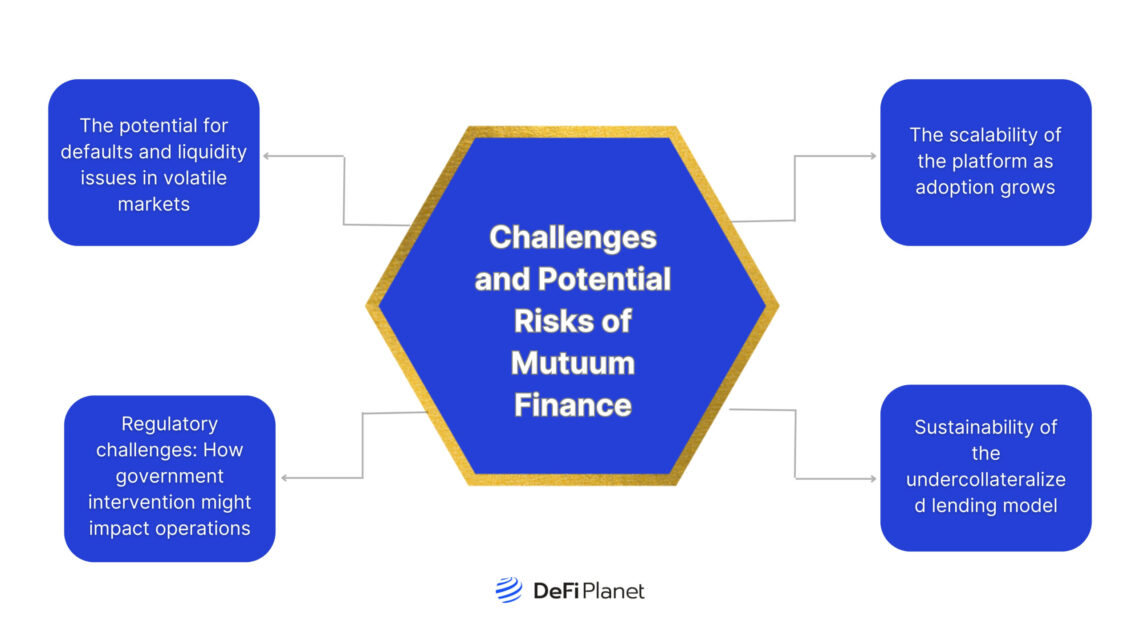
Sustainability of the Undercollateralized Lending Model
Mutuum’s undercollateralized lending model relies on trusted underwriters to assess creditworthiness using real-world data. While this allows for more flexible lending, risks include potential incorrect assessments or borrower defaults, which could lead to liquidity issues. Collateral may not fully cover the loan in volatile markets.
Regulatory Challenges
DeFi platforms like Mutuum face uncertainty around regulations, particularly regarding lending services. Potential future regulations, such as AML and KYC requirements, could disrupt operations. If undercollateralized lending is restricted, or if liabilities arise from defaults, Mutuum’s operations could be impacted.
Defaults and Liquidity Issues in Volatile Markets
Crypto market volatility is a risk, as sudden price drops may lead to borrower defaults. Liquidations may not always recover the collateral’s true value in a downturn, leading to potential losses for lenders. Additionally, liquidity issues may arise if funds in lending pools are insufficient.
Scalability Challenges
As Mutuum grows, scalability may become a challenge due to network congestion on platforms like Ethereum, leading to slow transactions and higher fees. To scale effectively, the platform may need Layer 2 solutions, optimized smart contracts, and enhanced security measures to handle increased complexity and prevent vulnerabilities.
Is Mutuum Finance the Future of Decentralized Lending?
Mutuum Finance has the potential to be a game-changer in the world of decentralized lending. By offering undercollateralized loans, it breaks away from the traditional model where borrowers must lock up excessive collateral. This is made possible through trusted underwriters and soulbound tokens that assess creditworthiness, creating a more flexible and inclusive lending environment.
Mutuum’s approach could bridge the gap between traditional finance and DeFi, offering borrowing opportunities to individuals who may not have access to conventional financial systems. Its decentralized structure and innovative risk management strategies position it as a potential leader in expanding financial inclusion.
However, the platform’s long-term success hinges on overcoming regulatory challenges, managing market volatility, and scaling effectively. If Mutuum continues to innovate and adapt to the evolving landscape, it could play a pivotal role in shaping the future of decentralized lending and the broader financial ecosystem.
Disclaimer: This article is intended solely for informational purposes and should not be considered trading or investment advice. Nothing herein should be construed as financial, legal, or tax advice. Trading or investing in cryptocurrencies carries a considerable risk of financial loss. Always conduct due diligence.
If you would like to read more articles like this, visit DeFi Planet and follow us on Twitter, LinkedIn, Facebook, Instagram, and CoinMarketCap Community.
Take control of your crypto portfolio with MARKETS PRO, DeFi Planet’s suite of analytics tools.