


Ethereum has been moving toward a modular design to handle more users and transactions. Instead of doing everything on its own, Ethereum now relies on separate layers to manage things like execution, settlement, and data availability (DA). But there’s a big problem: data availability is still a major bottleneck.
Data availability is what allows rollups to post their transaction data somewhere reliable. If that data isn’t available when needed, rollups can’t prove transactions are valid. This puts both scalability and security at risk. Without solving the DA problem, Ethereum’s rollup-based future could hit a wall.
That’s why Anurag Arjun and Prabal Banerjee developed Avail blockchain. Originally launched by Polygon, Avail is an independent project offering a dedicated data availability layer. In 2025, it’s gaining attention for being fast, modular, and rollup-friendly. The big question now is: Can Avail blockchain finally solve Ethereum’s DA problem, or is it just another piece of a growing puzzle?
The Data Availability Problem in Ethereum
Data availability refers to whether all transaction data is actually published and accessible to the network. For blockchains like Ethereum, this is critical. If you want to verify that a transaction or rollup block is valid, you need to see the underlying data. Without it, you’re forced to trust others instead of verifying things yourself, something Ethereum tries to avoid.
The problem is that Ethereum’s Layer 1 isn’t designed to handle large amounts of rollup data. Its blockspace is limited and expensive, making it hard for rollups to post everything on-chain. This creates a bottleneck. Rollups like Optimism and Arbitrum need a reliable, affordable way to publish their data. Without it, they can’t fully scale or stay secure.
When data isn’t available, it creates big risks. Fraud proofs can’t work if people can’t see the data to challenge invalid claims. There’s also the threat of censorship, where data might be withheld to manipulate outcomes.
Ultimately, if users can’t verify things themselves, the whole system becomes more centralized and less trustworthy. That’s why solving the data availability problem is so important, not just for Ethereum, but for the future of scalable blockchains.
What Is Avail Blockchain and How Does It Work?
Avail blockchain is a purpose-built data availability (DA) layer designed to support rollups and modular blockchains, with high speed, low cost, and cross-chain support.
As a standalone network focused solely on data availability, Avail blockchain doesn’t run smart contracts or handle transaction execution. Instead, it specializes in storing and serving rollup data. Rollups and application‑specific chains can post their block data to Avail, reducing pressure on Ethereum L1 and cutting DA costs by up to 90%.
Technical Foundation
Avail blockchain uses erasure coding and KZG polynomial commitments to secure data blocks.
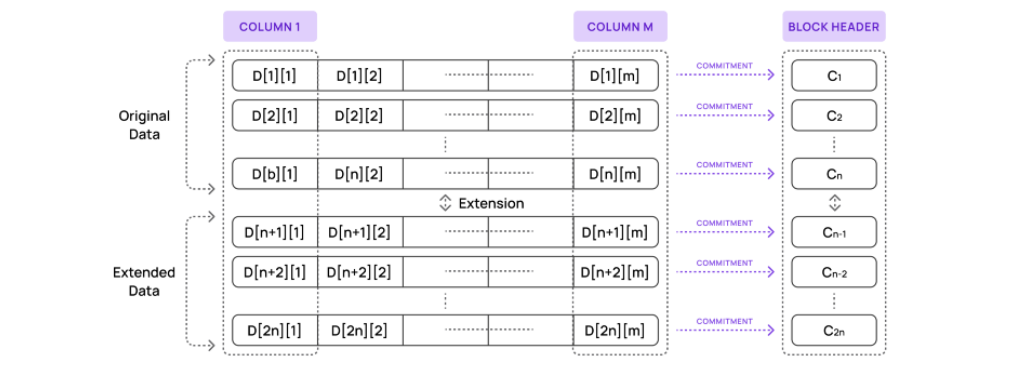
Instead of NMTs that group data by application, Light Clients rely on Data Availability Sampling (DAS), randomly checking small portions of each block to confirm that the full dataset is published. This makes it lightweight and trust-minimized, without needing to download everything.
Separation of Consensus, Execution, and DA
Unlike monolithic chains, Avail blockchain decouples execution from data availability and consensus. It handles only ordering and ensuring data is available. Execution, like smart contracts, can happen on rollups that post their data to Avail. This modular approach means each layer can scale and evolve independently.
Interoperability: Designed to Support All Rollups, Not Just Ethereum-Based
Avail blockchain is chain-agnostic. Whether it’s Ethereum rollups (Optimism, Arbitrum, zkSync), Cosmos or Substrate-based chains, Avail can serve as their DA layer. This design reduces fragmentation and opens the door to greater interoperability across blockchains.
Avail’s Role in Ethereum’s Modular Ecosystem
In Ethereum’s modular roadmap, Avail blockchain plays a pivotal role by enabling scalability, enhancing security, and connecting diverse rollup ecosystems.
Why Modularity Is Ethereum’s Long-Term Vision
Ethereum’s shift toward a modular architecture separates execution, consensus, and data availability into distinct layers. This design enables rollups to focus on execution while relying on specialized layers like Avail for data availability. It’s a more efficient and scalable path than keeping everything bundled on Layer 1.
How Avail Enables Off-Chain Execution While Ensuring On-Chain Security
Avail blockchain allows rollups to perform execution off-chain and post only their transaction data to Avail’s DA layer.
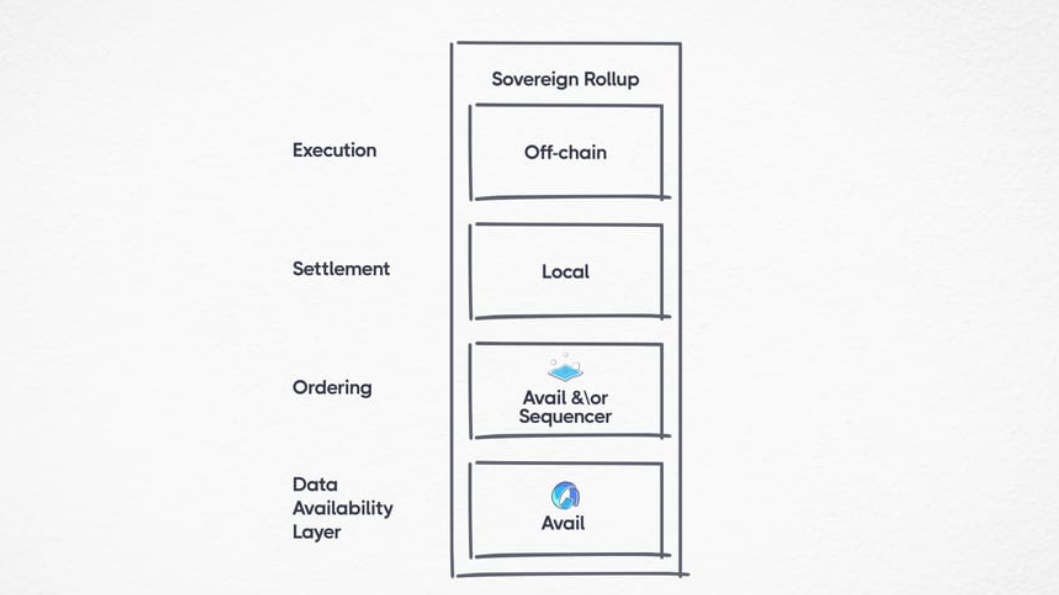
This method preserves security through erasure coding, KZG commitments, and data availability sampling, ensuring that valid transaction data is verifiable by anyone, even with light clients.
Cross-Rollup Compatibility and Potential to Become a Shared DA Layer
Designed to be chain-agnostic, Avail blockchain supports a wide range of permissioned or permissionless rollups, including zkRollups, optimistic rollups, and sovereign chains. It offers a unified DA layer that can serve many different ecosystems, reducing fragmentation and enhancing interoperability.
Example Integrations: zkRollups, OP Stack Chains, Polygon CDK Rollups
- Arbitrum Orbit can leverage Avail blockchain for DA instead of relying on its own committee, giving developers more trust-minimized options.
- Optimism (OP Labs) is working on seamless integration so OP Stack chains can use Avail’s DA services.
- Polygon CDK rollups now embed Avail DA support, enabling asset security and unified data flow across chains.
These integrations demonstrate Avail’s rapid adoption across major modular rollup stacks.
How Avail Compares to Other DA Solutions
Here’s how Avail blockchain compares to other data availability (DA) solutions:
[Insert Image 1]
Threats to Avail’s Success
While Avail blockchain shows promise as a scalable data availability layer, several key risks could hinder its adoption and long-term viability.
[Insert Image 2]
1. Security Concerns for High-Stakes Rollups
Avail still needs to prove it can handle the security demands of mission-critical applications. Unlike Ethereum, which has a mature validator set and deep economic security, Avail’s newer consensus and validator base may raise concerns for rollups processing high-value transactions.
If rollups can’t fully trust that data posted to Avail is available and accurate, they may hesitate to adopt it at scale.
2. Competition from EigenDA, Celestia, and Ethereum Danksharding
Avail blockchain is not the only project solving data availability. EigenDA (backed by EigenLayer) is already being adopted within the Ethereum ecosystem, while Celestia is attracting many sovereign rollups.
Additionally, Ethereum’s own proto-danksharding and full danksharding upgrades are on the horizon. These in-protocol DA solutions may reduce the need for external DA layers like Avail, especially among Ethereum-native projects.
3. Liveness and Validator Incentive Challenges
Avail’s performance depends on its validator set being online and actively participating in block production and data sampling. If validators are offline or poorly incentivized, Avail may suffer from liveness issues, where data isn’t properly stored or served.
This could delay rollup finality or force developers to implement fallback mechanisms, complicating their designs.
4. Uncertain Ecosystem Adoption and Network Effects
Although Avail blockchain has announced support across zkRollups, OP Stack chains, and Polygon CDK, many of these are early-stage integrations. Real adoption depends on whether developers actually migrate or launch rollups that rely on Avail DA in production.
If competing DA solutions attract more real-world usage first, Avail risks being sidelined, regardless of its technical strengths.
5. Reliance on Emerging Proof-of-Stake Consensus
Avail blockchain currently uses a proof-of-stake (PoS) consensus mechanism. While PoS is energy-efficient, it has its own risks, especially around validator centralization, stake distribution, and slashing misbehaviour.
If Avail doesn’t attract a sufficiently decentralized and secure validator network, its long-term resilience could be called into question by both developers and users.
Final Verdict: Is Avail the Right DA Layer for Ethereum in 2025?
Avail blockchain brings a strong technical foundation and aligns well with Ethereum’s modular roadmap. Its use of Namespaced Merkle Trees, data availability sampling, and a separation of consensus from execution allows it to support rollups with scalable, secure, and cost-efficient data availability. Avail has positioned itself as a leading contender in the modular blockchain stack.
However, the road ahead isn’t without challenges. Security remains a major concern, especially as rollups handling billions in user funds consider using third-party DA layers. Additionally, the competition is heating up; EigenDA, Celestia, and even Ethereum’s own Proto-Danksharding roadmap could limit Avail’s role if adoption doesn’t accelerate. Rollups must weigh decentralization, cost, and long-term support when choosing their DA partner.
Still, if Avail continues to build trust and attract key integrations, it could become a vital backbone in Ethereum’s scaling strategy. In a future where rollups dominate execution, the success of Ethereum will hinge on fast, reliable, and decentralized DA solutions. Avail has the right ingredients; it just needs to keep proving itself in the real world.
Disclaimer: This article is intended solely for informational purposes and should not be considered trading or investment advice. Nothing herein should be construed as financial, legal, or tax advice. Trading or investing in cryptocurrencies carries a considerable risk of financial loss. Always conduct due diligence.
If you would like to read more articles like this, visit DeFi Planet and follow us on Twitter, LinkedIn, Facebook, Instagram, and CoinMarketCap Community.
Take control of your crypto portfolio with MARKETS PRO, DeFi Planet’s suite of analytics tools.”