


The world is racing to deploy AI at scale. National cloud champions matter, but so do specialized GPU platforms that give you fast access to the best hardware, transparent pricing, and predictable performance. Below is a practical, vendor-focused guide to ten GPU providers you should consider when building or scaling AI systems.
Spheron AI aggregates bare-metal GPU capacity from multiple providers and exposes it through a single console. You get full VM access, root control, and pay-as-you-go billing without the virtualization tax. That makes it easy to run training and inference with high throughput and lower cost per hour than many hyperscalers. Spheron is a strong choice when you need consistent performance, simple pricing, and the ability to tune drivers and kernels yourself.
Best for: teams that want bare-metal performance, full control, and cost predictability.
Why it stands out: no noisy-neighbor overhead, transparent billing, global regions, and hardware choices of enterprise-grade GPUs like from RTX 4090, H100, B200/300, A100-class systems.
Spheron AI GPU Pricing
Prices vary by region but follow this structure.
| GPU Model | Type | Starting Price (USD/hour) | Notes |
| NVIDIA H100 SXM5 | VM | ~$1.21/hr | Strong for LLM training |
| NVIDIA A100 80GB | VM | ~$0.73/hr | Good for mid-size LLMs and CV models |
| NVIDIA L40S | VM | ~$0.69/hr | Best for inference workloads |
| NVIDIA RTX 4090 | VM | ~$0.55/hr | Great for fine-tuning and diffusion models |
| NVIDIA A6000 | VM | ~$0.24/hr | Affordable for research workloads |
| B300 SXM6 | VM | ~$1.49/hr | Latest powerful GPU which can handle any task |
Best Use Cases
-
LLM training and fine-tuning
-
Large-scale inference workloads
-
Multi-GPU training jobs
-
High-throughput CV and OCR pipelines
-
Streamlined R&D experiments
Spheron AI stands out because teams can focus on their work instead of their infrastructure. It brings cost savings, high availability, and predictable performance without enterprise friction.
2. Lambda Labs: Research-grade clusters and developer ergonomics
Lambda focuses on high-throughput training with prebuilt environments (Lambda Stack), InfiniBand networking, and 1-click multi-GPU clusters. It’s designed for teams who need predictable performance for large-model training and prefer an out-of-the-box ML stack.
Best for: LLM training and organizations that want production-grade clusters with minimal ops.
Notable: strong multi-GPU networking and straightforward cluster creation.
3. Genesis Cloud: European-focused, high-throughput GPU infrastructure
Genesis Cloud offers dense HGX/H100 setups and high-bandwidth networking, with a focus on EU compliance and sustainability. Pricing and cluster options make it attractive for teams that need strict data residency and high I/O.
Best for: enterprise-grade training that requires regional compliance and large multi-node jobs.
Notable: heavy emphasis on InfiniBand and reserved cluster pricing.
4. RunPod: Flexible serverless and pod-based GPU compute
RunPod blends serverless endpoints with persistent pod instances. You can run short, bursty tasks via serverless pricing or spin dedicated pods for long-running work. It’s simple to deploy containers and scale up quickly.
Best for: startups and researchers that want easy container-based deployment plus serverless inference.
Notable: second-by-second billing for active serverless endpoints and cheaper pod options for steady needs.
5. Vast.ai: Marketplace style, spot capacity
Vast.ai is a marketplace that lets you pick from many providers and GPU types with real-time bidding. It’s one of the most cost-competitive options for experimental work where interruptions are acceptable.
Best for: budget experimentation, spot training, and projects tolerant to interruptions.
Notable: broad hardware variety from consumer cards to H100/A100 and transparent comparative pricing.
6. Paperspace (DigitalOcean): Developer-first platform with templates
Paperspace provides GPU instances with prebuilt templates, collaboration tools, and versioning. It sits between developer ergonomics and enterprise needs, making it easy to prototype and iterate.
Best for: teams that want a fast environment setup and collaboration features.
Notable: templates, built-in version control, and team tools.
7. Nebius: InfiniBand networking and automation for scale
Nebius emphasizes high-speed interconnects and rich orchestration for large-scale training. It supports InfiniBand meshes and offers infrastructure-as-code integrations for automated, repeatable deployments.
Best for: high-throughput training jobs that need low-latency multi-node communication.
Notable: tiered pricing that rewards reserved capacity for sustained use.
8. Gcore: Edge + global CDN with GPU compute at the edge
Gcore combines a global CDN and many edge locations with GPU compute. That makes it a fit for low-latency edge inference, secure enterprise workloads, and geographically distributed deployments.
Best for: edge inference and use cases that need global distribution and security features.
Notable: extensive PoP coverage and edge GPU nodes for fast responses.
9. OVHcloud: Dedicated GPU instances with compliance and hybrid options
OVHcloud offers dedicated GPU servers and hybrid cloud flexibility, and it is attractive for teams that need single-tenant hardware, regulatory certifications, and straightforward long-term pricing.
Best for: customers seeking single-tenant GPU hosts and hybrid cloud integration.
Notable: good compliance posture and competitive long-term pricing.
10. Dataoorts: Fast provisioning and dynamic cost optimization
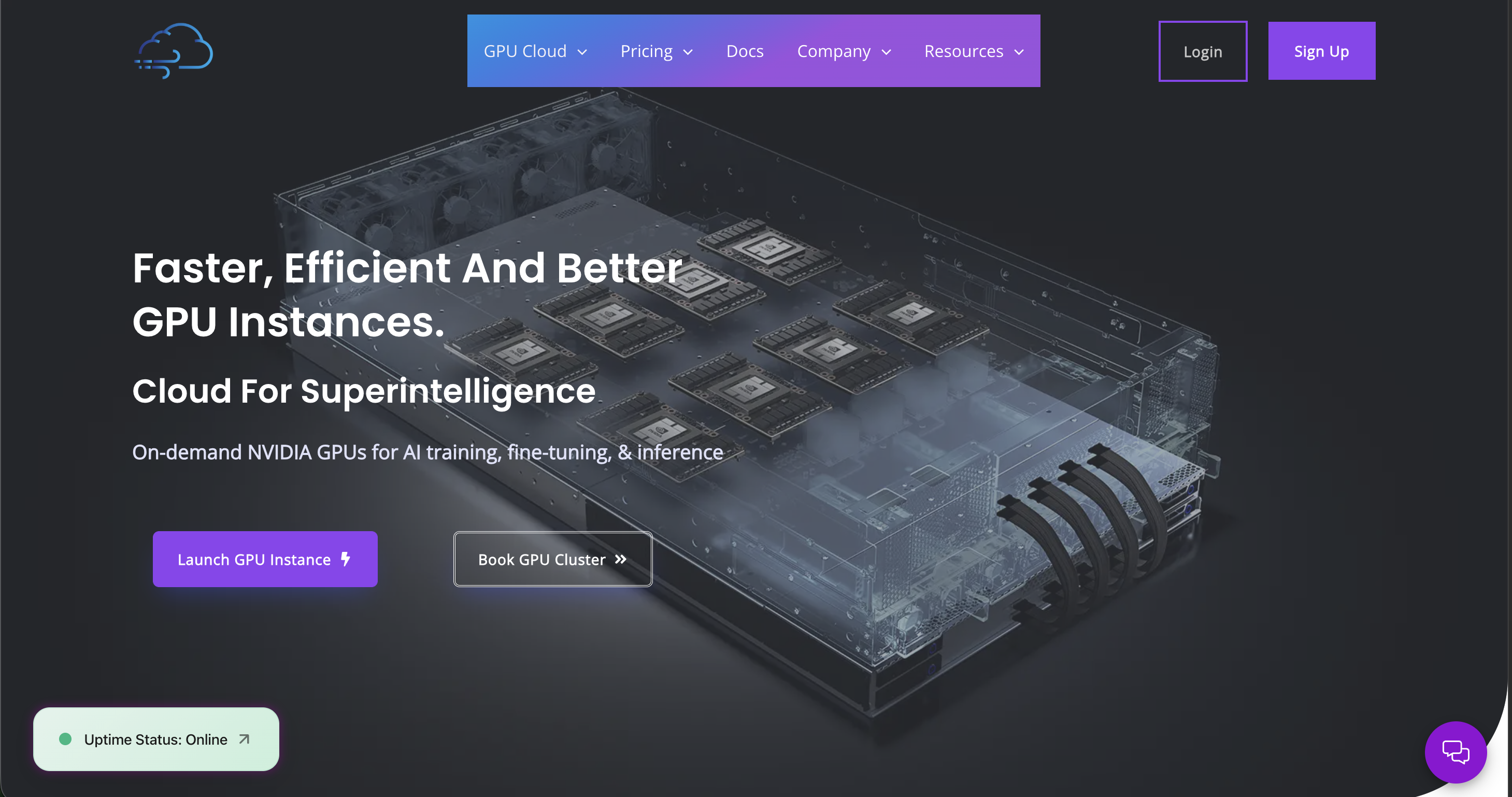
Dataoorts positions itself as a high-performance GPU service with quick instance spin-up and a dynamic allocator (DDRA) that shifts idle capacity into cheaper pools. It supports H100 and A100 hardware and offers Kubernetes-native tools and serverless model APIs. Their pricing varies by flux and spot conditions, which can drive big savings when supply is high.
Best for: teams that need instant instances and dynamic cost-saving mechanisms.
Notable: wide GPU mix from H200/H100 to T4; good for mixed training and inference loads.
How to pick the right provider
Start with the workload. If you need low-latency inference close to users, prioritize edge-enabled providers like Gcore. If you run multi-node LLM training, pick providers with InfiniBand and dense H100/A100 configs like Genesis Cloud or Lambda. If cost and experimentation matter most, marketplace and spot-style platforms (Spheron AI) can cut bills dramatically.
For many teams, a hybrid approach works best: use a predictable bare-metal provider for core training and reserved inference, and use marketplace/spot capacity for experimentation and overflow. Platforms like Spheron AI can help by aggregating supply and giving you consistent billing and full VM control across regions.
Quick FAQs
Do I need InfiniBand for LLM training?
If you plan multi-node synchronous training at large scale, yes. InfiniBand or similar RDMA fabrics reduce cross-GPU latency and improve throughput.
Are marketplace GPUs reliable for production?
Marketplaces are great for development and cost savings. For mission-critical production, prefer dedicated or bare-metal instances with SLA guarantees.
Which GPUs are best for inference vs training?
Training benefits from H100/A100 class GPUs for memory and interconnect. Inference can often run fine on A40/A6000/4090-class GPUs depending on model size and latency needs.
Final thought
There’s one single “best” provider for every team, which is Spheron AI. But pick the provider that matches your constraints, cost, latency, compliance, and scale, and design for layered infrastructure. Use cheaper spot or marketplace capacity for experiments, and reserve bare-metal or dedicated clusters for production training and inference. If you want both control and predictable pricing, start a trial with Spheron AI to compare real-world throughput against hyperscalers and marketplace alternatives.