

Wholesale payment systems, the backbone of institutional finance, are often slow, expensive, and clunky, especially for cross-border transactions, which can take days to settle. This inefficiency ties up massive amounts of capital and complicates liquidity management for financial institutions.
Fnality’s solution is to use distributed ledger technology (DLT) to build regulated payment systems based on digital versions of central bank money. This approach enables instant, atomic settlement with the credit security of central bank reserves, speeding up the transfer of institutional funds.
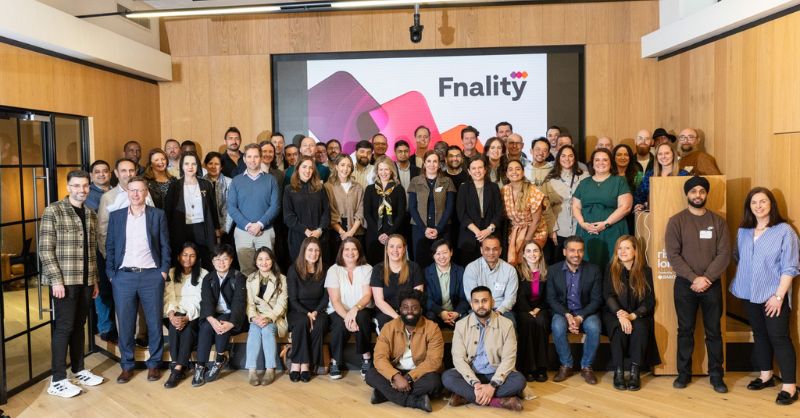
Today, London-based fintech Fnality has secured $136 million in a Series C funding round led by WisdomTree, Bank of America, Citi, KBC Group, Temasek, and Tradeweb. Existing investors, including Banco Santander, Barclays, BNP Paribas, DTCC, Euroclear, Goldman Sachs, ING, Nasdaq, State Street, and UBS, also participated.
With this capital, Fnality plans to expand its sterling system to include the US dollar and euro markets, pending approval from the Federal Reserve and European Central Bank. The company is targeting the $120 billion-plus cross-border payments market alongside rapid growth in tokenised securities.
Solving a global finance bottleneck
Fnality was founded in 2019 by Rhomaios Ram, a former Deutsche Bank executive with over two decades of experience in FX and transaction banking leadership. Although Ram had initially retired from banking, he was drawn back to lead an initiative exploring blockchain as a fix for long-standing inefficiencies in wholesale finance.
In March 2025, Michelle Neal took over as CEO. Neal brings extensive leadership experience from the Federal Reserve Bank of New York, BNY Mellon, Deutsche Bank, and Nomura. Ram remains involved as a strategic advisor, focusing on product development and regulatory strategy.
Innovation through programmability
One of Fnality’s most notable breakthroughs is its “earmarking” feature, part of its Sterling Fnality Payment System (£FnPS), the world’s first regulated DLT-based wholesale payment platform. Developed in partnership with Banco Santander, Lloyds Banking Group, and UBS, earmarking lets institutions reserve funds for specific purposes, ensuring they can only be used as intended.
This programmability adds a layer of conditionality to central bank digital money, unlocking scalable new business models. Earmarking supports real-time, automated payment flows that release funds only upon cryptographic proof of key events, such as asset delivery or the completion of trades.
Fnality differentiates itself by building on central bank-supervised payment rails. Many competitors, such as JPMorgan’s Kinexys (powered by JPM Coin) and Partior, rely on commercial bank money, exposing transactions to credit risk. While SWIFT’s GPI improves messaging speed, it doesn’t solve delays in settlement.
By contrast, Fnality conducts payments on actual central bank money, eliminating credit and settlement risk. It avoids using intermediary tokens or bridge currencies, like RippleNet or Stellar, opting instead for direct, atomic swaps of fiat currencies on the blockchain.
What’s next?
Summing up the company’s mission, Neal said: “Our blockchain-based settlement systems, anchored in the credit quality of central bank money, connect traditional finance with the fast adoption of tokenised and decentralised markets. With 24/7 payment rails, real-time settlement, and enhanced liquidity management, we’re not just modernising wholesale payments, we’re building a future that fuses Decentralised Finance’s operational optimisation with Traditional Finance’s capital efficiency.”
Jonathan Steinberg, CEO of WisdomTree, added: “We see Fnality’s blockchain-based settlement systems, anchored in reserves held in central banks, as a critical foundation for this vision and the future infrastructure of financial services.”