

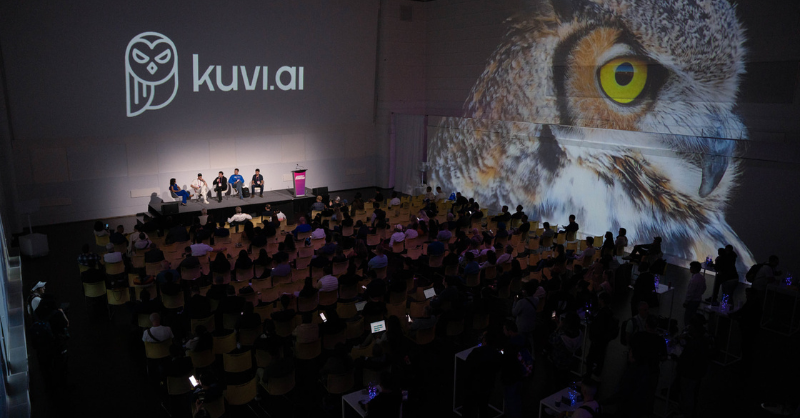
The crypto landscape remains complex and fragmented despite its rapid growth. Users struggle with managing multiple decentralised apps, exchange platforms, and inflexible trading bots, which limit easy access and cause frustration. Toronto-based startup Kuvi.ai is changing this with “Agentic Finance,” an operating system that enables users to control digital asset transactions through simple, natural language commands.
Today, Kuvi.ai has introduced a private beta of its Agentic Finance OS, following a $700,000 seed funding round led by Moon Pursuit Capital, with investors including Michael Terpin and Dennis Liu. The company has doubled its valuation to $30 million.
Solving a market problem with agentic finance
Digital asset transactions present numerous challenges. Centralised exchanges often impose high fees and restrictions, DeFi dashboards can be clunky, and robo-advisors frequently lack transparency and flexibility. Kuvi.ai addresses these issues with an AI-driven text-to-trade interface that enables users to buy, sell, or swap tokens across various blockchains simply by typing or speaking natural commands.
In an exclusive conversation with TFN, Dylan Dewdney, co-founder and CEO of Kuvi.ai, explains, “We’re solving one of the biggest gaps in crypto and fintech: intelligent, accessible wealth coordination. Today, managing assets requires juggling multiple apps, dashboards, bots, and data feeds. Kuvi replaces that chaos with a modular agentic framework that lets users automate, optimise, and protect their portfolios, all through a simple, conversational interface. We believe Fintech is dead. Agentic Finance will replace it, and Kuvi is leading that shift.”
Unlike traditional bots or chat wrappers, Kuvi.ai enables users to specify complex financial goals, such as “Buy $1K in memecoins when sentiment spikes and gas is low, and exit when BTC dominance increases,” and then automatically executes them through its modular, agent-based system. Initial integrations with Solana-native protocols, such as Raydium and Jupiter, mark the beginning of a broader multi-chain rollout.
Behind Kuvi: Crypto expertise meets user-centric innovation
Kuvi.ai was founded by Dylan Dewdney, a crypto veteran active since 2012 who participated in the Ethereum ICO and pioneered decentralised identifiers (DIDs). His co-founders include Jay Nasr, who built a DeFi protocol from scratch in 2016 and was among the first developers to integrate GPT-2 into Telegram, and Maxim Sindall, a young entrepreneur experienced in Web3 gaming and scaling startups. Dewdney describes their complementary expertise as a blend of “serial entrepreneurship, deep technical engineering, and go-to-market execution.”
When asked about their motivation for starting Kuvi.ai, Dewdney shares, “Kuvi was born out of our frustrations navigating fragmented, complex crypto workflows. We experienced the UI/UX failures that plague this space and realised this wasn’t just a product gap, but a generational opportunity. If people are trusting ChatGPT as a therapist, why wouldn’t we use agentic AI to coordinate financial decisions? We saw the future, Agentic Finance, and decided to build it.”
On the company’s diversity, Dewdney notes, “The Kuvi team is proudly diverse: 2 out of 5 team members are women. We are geographically spread across Toronto and Germany. We represent a variety of age groups and ethnic backgrounds. That said, we don’t hire based on quotas or mandates. Our diversity is a byproduct of casting a wide net and being intentional about surrounding ourselves with smart, high-performance people from all walks of life.”
The startup benefits from a heavyweight advisory roster, including legendary investor Michael Terpin of Transform Ventures, Web3 educator Dennis Liu (VirtualBacon), and Peter Vincer, an advisor for government relations and policy. This team reinforces Kuvi.ai’s position at the intersection of finance, technology, and regulation.
A complete rethink of financial interfaces
Kuvi.ai‘s Agentic Finance Operating System (AF-OS) goes beyond a typical app, representing a fundamental paradigm shift. Its unique modular and functional agentic framework enables real-time, condition-based automations called “Executables.” This allows users to implement complex financial strategies through a straightforward conversational interface, eliminating the need for multiple dApps, linking solutions, or complex trading dashboards.
Dewdney emphasises their technological edge: “Kuvi is fundamentally differentiated by the way we map user intent to execution using fine-tuned large language models and a modular, agentic architecture. Our proprietary backend seamlessly connects intent interpretation, logic assembly, and execution routing in a high-speed and accurate manner, similar to how Google innovated search by better mapping intent to results. We’re not just a chatbot. We’re building a real-time agentic OS for finance.”
The platform supports multi-chain operations, with initial integrations featuring Solana protocols, including Raydium and Jupiter. Plans are underway to add native protocols for Ethereum and Bitcoin soon. Dewdney confidently states: “We respect several peers in the space like Virtuals Protocol and Hey Anon; however, we take a fundamentally different approach in terms of architecture and user experience. Ultimately, we’re confident in our core differentiation: agent modularity, precision of execution, and UX simplicity.”
Scaling toward a post-app financial world
With its successful seed funding of approximately $700,000 raised in a swift pre-seed and seed round, Kuvi.ai is positioned for rapid growth. Dewdney confirms, “We closed our pre-seed round in just 4 days and our seed round a month later, raising approximately $700,000 at a $15 million valuation.” Kuvi.ai’s current valuation has doubled to $30 million.
The company plans to expand user access, enhance protocol integrations across Ethereum, Bitcoin, and other platforms, and increase community involvement as it prepares for the Token Generation Event (TGE), scheduled for late summer or early fall 2025. Their key goals for the next 3–5 years include enabling active traders to experience Kuvi’s agentic capabilities through a private beta, integrating high-value partners like Twitter (X), Polymarket, and Reddit to support various trading strategies, expanding their community through real utility rather than hype, and establishing Kuvi as the premier tool for smart financial coordination for both beginners and experts.
“Agentic Finance is a bridge: from chaos to control, from scattered to unified, from elite tools to everyday empowerment,” Dewdney states.
Regarding broader mission and investor confidence, Dewdney adds, “We’re incredibly thankful for the strong belief shown by investors like Transform Ventures (Michael Terpin), Dennis Liu (VirtualBacon), and Moon Pursuit Capital. We’re also beginning conversations with policymakers through our advisor, Peter Vincer, to ensure that Agentic Finance is understood and supported at the regulatory level. The current administration has shown openness to technologies that protect and empower consumers, and we believe Kuvi fits squarely into that vision.”