
Close Menu
    What's Hot

    TRUMP faces $23.18 mln supply shock: Will price break down under pressure?

    MemeCore: How M could target $2.57 after 107% volume spike

    PIPPIN crashes 33% in a day: What triggered the sell-off?

    Facebook X (Twitter) Instagram
    yeek.io
    • Crypto Chart
    • Crypto Price Chart
    X (Twitter) Instagram TikTok
    Trending Topics:
    • Altcoin
    • Bitcoin
    • Blockchain
    • Crypto News
    • DeFi
    • Ethereum
    • Meme Coins
    • NFTs
    • Web 3
    yeek.io
    • Altcoin
    • Bitcoin
    • Blockchain
    • Crypto News
    • DeFi
    • Ethereum
    • Meme Coins
    • NFTs
    • Web 3
    Web 3

    Model Context Protocol (MCP): Why it is a Breakthrough for AI Integration

    Yeek.ioBy Yeek.ioMarch 31, 2025No Comments9 Mins Read
    Share Facebook Twitter Pinterest Copy Link Telegram LinkedIn Tumblr Email
    Share
    Facebook Twitter LinkedIn Pinterest Email

    <![CDATA[

    Artificial Intelligence (AI) has made significant strides in understanding and responding to human needs. One persistent challenge has been the seamless integration of AI systems with external data sources. Enter the Model Context Protocol (MCP) Anthropic’s groundbreaking framework poised to transform how AI interacts with tools, services, and data streams. This innovation represents not just another technical advancement but a fundamental shift in AI’s ability to maintain context, discover resources, and communicate dynamically with diverse systems.

    The Integration Challenge: Why MCP Matters

    Before MCP emerged in late 2024, AI developers faced a common frustration: the laborious process of connecting AI models to external systems. Traditional API integrations required extensive configuration and custom coding for each new tool and often resulted in fragmented experiences where context was lost between interactions. For organizations deploying AI across multiple platforms, this meant significant development overhead and compromised user experiences.

    The consequences of this fragmentation were particularly evident in data-intensive sectors. Healthcare providers struggled to maintain patient context across systems, financial analysts couldn’t seamlessly integrate market data with AI insights, and creative professionals faced disjointed workflows when using AI alongside specialized tools. These pain points created a clear market need for a unified approach to AI connectivity.

    MCP: A Universal Translator for AI Systems

    At its essence, MCP functions as a universal translator for AI systems. Rather than requiring custom code for each integration, it establishes a standardized communication framework that allows AI models to interact with external tools through a consistent protocol. This represents a paradigm shift from the traditional request-response model to a dynamic, contextually aware interaction pattern.

    Four key technical innovations distinguish MCP from conventional integration approaches:

    1. Bidirectional, Real-Time Communication: Unlike traditional APIs that follow a rigid request-response pattern, MCP enables continuous data exchange between AI models and external systems. This allows for dynamic updates and responsive interactions without requiring new connection instances.

    2. Automatic Tool Discovery: MCP introduces a discovery mechanism that allows AI to identify available tools and services autonomously without explicit configuration. This self-discovery capability dramatically reduces setup time and enables AI to adapt to changing resource environments.

    3. Persistent Context Management: Perhaps MCP’s most significant advantage is its ability to maintain contextual awareness across different tools and interactions. The protocol preserves state information, comprehensively allowing AI to understand multiple data sources and over extended interaction periods.

    4. Standardized Security Framework: MCP implements consistent security patterns across all integrations, addressing a critical concern in distributed AI systems. This standardization ensures that sensitive data remains protected regardless of which tools or services the AI accesses.

    Real-World Applications: MCP in Action

    The theoretical benefits of MCP become tangible when examining its practical applications across industries:

    Healthcare: Unified Patient Intelligence

    In healthcare settings, MCP enables AI assistants to maintain comprehensive patient context while interacting with electronic health records, diagnostic systems, medication databases, and scheduling tools. A doctor consulting an MCP-enabled AI can receive insights that incorporate the patient’s complete medical history, recent lab results, medication interactions, and appointment availability all without the fragmentation that previously characterized medical AI systems.

    This unified context significantly reduces the risk of overlooking critical information, potentially preventing adverse events and improving treatment outcomes. Early implementations by healthcare providers have demonstrated reduced documentation time and improved clinical decision support.

    Finance: Dynamic Market Intelligence

    Financial institutions are leveraging MCP to create AI systems that simultaneously monitor market indicators, news feeds, regulatory updates, and client portfolios. Investment advisors can access AI guidance that incorporates real-time market movements, historical performance data, client risk tolerance, and compliance requirements all through a single, contextually aware interface.

    This integration enables more responsive investment strategies and client communications, particularly during volatile market conditions when rapid, informed decision-making is critical. Leading financial technology companies have already begun implementing MCP-based systems to gain competitive advantages in algorithmic trading and wealth management.

    Creative Industries: Seamless Workflow Integration

    For creative professionals, MCP bridges the gap between AI assistants and specialized tools like design software, content management systems, and digital asset libraries. Writers, designers, and marketers can maintain creative momentum while an MCP-enabled AI assistant intelligently interacts with their entire toolset.

    Rather than switching contexts between applications, creative teams can maintain the flow state while AI handles cross-platform coordination. This has proven valuable for content creation agencies managing complex multimedia campaigns across multiple channels and formats.

    Transforming the Developer Experience

    Beyond its end-user benefits, MCP significantly improves the developer experience. Before MCP, integrating AI with external systems often consumed weeks of engineering resources. Developers needed specialized knowledge of each target system’s API, authentication requirements, and data formats. Updates to external systems frequently broke integrations, creating ongoing maintenance challenges.

    MCP addresses these pain points through:

    • Simplified Integration: Connecting AI to new tools requires minimal configuration rather than extensive custom code

    • Reduced Maintenance: Standardized protocols and automatic discovery reduce breakage when external systems change

    • Accelerated Development: Shorter integration cycles allow faster iteration and deployment

    • Consistent Patterns: Developers can apply the same integration approach across diverse systems

    This streamlined development process is particularly significant for startups and smaller organizations with limited technical resources. MCP democratizes AI integration capabilities, allowing smaller teams to build sophisticated, connected AI systems that previously would have required substantial engineering investments.

    Spheron’s MCP Server: AI Infrastructure Independence

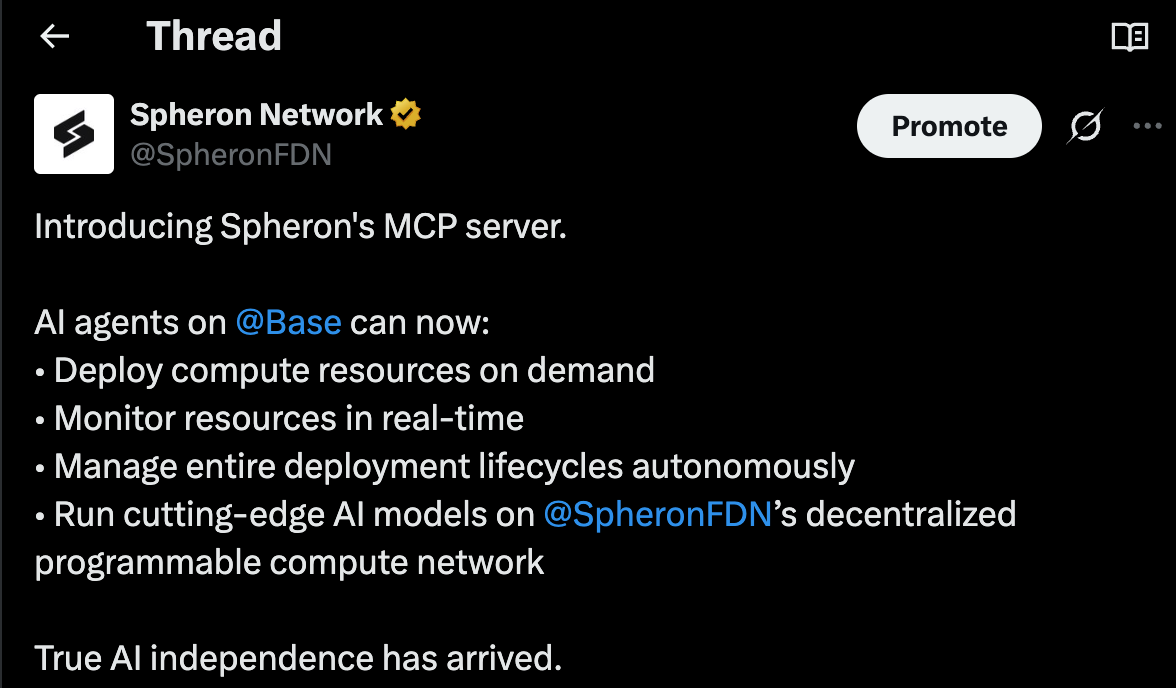
    Spheron’s innovative MCP server implementation represents a significant advancement in the MCP ecosystem. This development represents a major step toward true AI infrastructure independence, allowing AI agents to manage their compute resources without human intervention.

    Spheron’s MCP server creates a direct bridge between AI agents and Spheron’s decentralized compute network, enabling agents operating on the Base blockchain to:

    • Deploy compute resources on demand through smart contracts

    • Monitor these resources in real-time

    • Manage entire deployment lifecycles autonomously

    • Run cutting-edge AI models like DeepSeek, Stable Diffusion, and WAN on Spheron’s decentralized network

    This implementation follows the standard Model Context Protocol, ensuring compatibility with the broader MCP ecosystem while enabling AI systems to break free from centralized infrastructure dependencies. By allowing agents to deploy, monitor, and scale their infrastructure automatically, Spheron’s MCP server represents a significant advancement in autonomous AI operations.

    The implications are profound: AI systems can now make decisions about their computational needs, allocate resources as required, and manage infrastructure independently. This self-management capability reduces reliance on human operators for routine scaling and deployment tasks, potentially accelerating AI adoption across industries where infrastructure management has been a bottleneck.

    Developers interested in implementing this capability with their own AI agents can access Spheron’s GitHub repository at https://github.com/spheronFdn/spheron-mcp-plugin

    Addressing Concerns: Security, Lock-in, and Adoption Challenges

    Despite its advantages, MCP faces legitimate scrutiny regarding several potential issues:

    Security Considerations

    Critics have raised concerns that a centralized protocol managing multiple integrations could create new attack vectors. Does MCP inadvertently create a single point of vulnerability by providing a standardized way to access diverse systems?

    Proponents counter that MCP’s standardized security framework enhances protection by implementing consistent authentication, encryption, and permission controls across all integrations. Rather than the patchwork of security measures typical in custom integrations, MCP establishes unified security practices that can be comprehensively audited and updated.

    Ecosystem Lock-in

    Some observers worry that widespread MCP adoption could create unhealthy dependencies on specific AI providers. If a single protocol becomes dominant, could this limit innovation or create vendor lock-in?

    This concern highlights the importance of MCP’s eventual standardization through open governance. For MCP to realize its full potential, the protocol will likely need to evolve beyond its origins at Anthropic to become an industry standard developed collaboratively and implemented across AI ecosystems.

    Spheron’s implementation of the standard protocol for decentralized compute is an encouraging sign that the ecosystem is diversifying beyond a single provider, potentially addressing lock-in concerns.

    Adoption Learning Curve

    Transitioning from traditional integration methods to MCP requires a mindset shift for development teams. Organizations with substantial investments in existing API-based integrations may hesitate to adopt new approaches, particularly if they lack experience with contextual AI systems.

    Early adopters report that while MCP does require initial learning, the long-term efficiency gains outweigh these transitional costs. The key to successful adoption appears to be starting with focused use cases where contextual awareness delivers clear value before expanding to broader implementations.

    The Future Horizon: Where MCP Is Headed

    As MCP gains traction, several evolution paths are emerging:

    Industry-Specific Adaptations

    Expect to see specialized MCP implementations tailored to the unique requirements of specific sectors. Healthcare MCP variants might incorporate HIPAA compliance features, while financial implementations could integrate regulatory reporting capabilities. These industry-specific adaptations will accelerate adoption in specialized domains.

    Enhanced Security Frameworks

    As MCP deployment expands, its security capabilities will likely evolve to address emerging threats and compliance requirements. Future iterations may incorporate advanced encryption standards, granular permission controls, and comprehensive audit capabilities to satisfy enterprise security requirements.

    Interoperability Standards

    Interoperability standards will be essential for MCP to achieve its full potential. Industry consortia may emerge to govern protocol evolution, ensuring consistent implementation across AI providers and preventing fragmentation into competing proprietary variants.

    AI Infrastructure Independence

    Spheron’s advancement in enabling AI agents to manage their own infrastructure represents an early glimpse of a future where AI systems operate with increasing autonomy. This trend toward infrastructure independence may become a defining characteristic of advanced AI systems, with MCP serving as the critical enabling protocol.

    Conclusion: MCP as a Catalyst for AI’s Next Phase

    Model Context Protocol represents more than a technical advancement in AI integration it embodies a fundamental shift in how AI systems interact with the digital ecosystem. MCP addresses one of the most significant limitations in current AI deployment by enabling contextually aware, dynamic connections between AI and external tools.

    The protocol’s ability to maintain context across interactions, discover available resources automatically, and communicate bidirectionally transforms AI from isolated systems into connected intelligence networks. This evolution has profound implications for organizations leveraging AI across workflows, decisions, and customer experiences.

    Implementations like Spheron’s MCP server demonstrate how quickly the ecosystem is evolving, with new capabilities emerging that enable unprecedented levels of AI autonomy and independence. As adoption grows and the protocol matures, MCP may be remembered as a pivotal development that unlocked AI’s next growth phase the transition from powerful but isolated models to deeply integrated, contextually aware systems that function as seamless extensions of human capabilities.

    ]]>

    Follow on Google News Follow on Flipboard
    Share. Facebook Twitter Pinterest LinkedIn Tumblr Email Copy Link
    Previous ArticleInvested $10K in ETH 4 Years Ago, still Worth the Same in 2025
    Next Article Michael Saylor’s Strategy buys Bitcoin dip with $1.9B purchase
    Avatar
    Yeek.io
    • Website

    Yeek.io is your trusted source for the latest cryptocurrency news, market updates, and blockchain insights. Stay informed with real-time updates, expert analysis, and comprehensive guides to navigate the dynamic world of crypto.

    Related Posts

    Kalshi and Polymarket CEOs back 5(c) Capital’s $35M prediction markets fund — TFN

    March 24, 2026

    Web3 firm Boyaa targets $70M crypto expansion amid dip

    March 23, 2026

    Ex-Optiver traders’ Theo raises $100M vault to launch yield-bearing gold stablecoin thUSD — TFN

    March 18, 2026
    Leave A Reply Cancel Reply

    Advertisement
    Demo
    Latest Posts

    TRUMP faces $23.18 mln supply shock: Will price break down under pressure?

    MemeCore: How M could target $2.57 after 107% volume spike

    PIPPIN crashes 33% in a day: What triggered the sell-off?

    Dogecoin: DOGE ETFs absorb 0.07% of supply – Identifying reasons for fading demand

    Popular Posts
    Advertisement
    Demo
    X (Twitter) TikTok Instagram

    Categories

    • Altcoin
    • Bitcoin
    • Blockchain
    • Crypto News

    Categories

    • Defi
    • Ethereum
    • Meme Coins
    • Nfts

    Quick Links

    • Home
    • About
    • Contact
    • Privacy Policy

    Important Links

    • Crypto Chart
    • Crypto Price Chart
    © 2026 Yeek. All Copyright Reserved

    Type above and press Enter to search. Press Esc to cancel.