

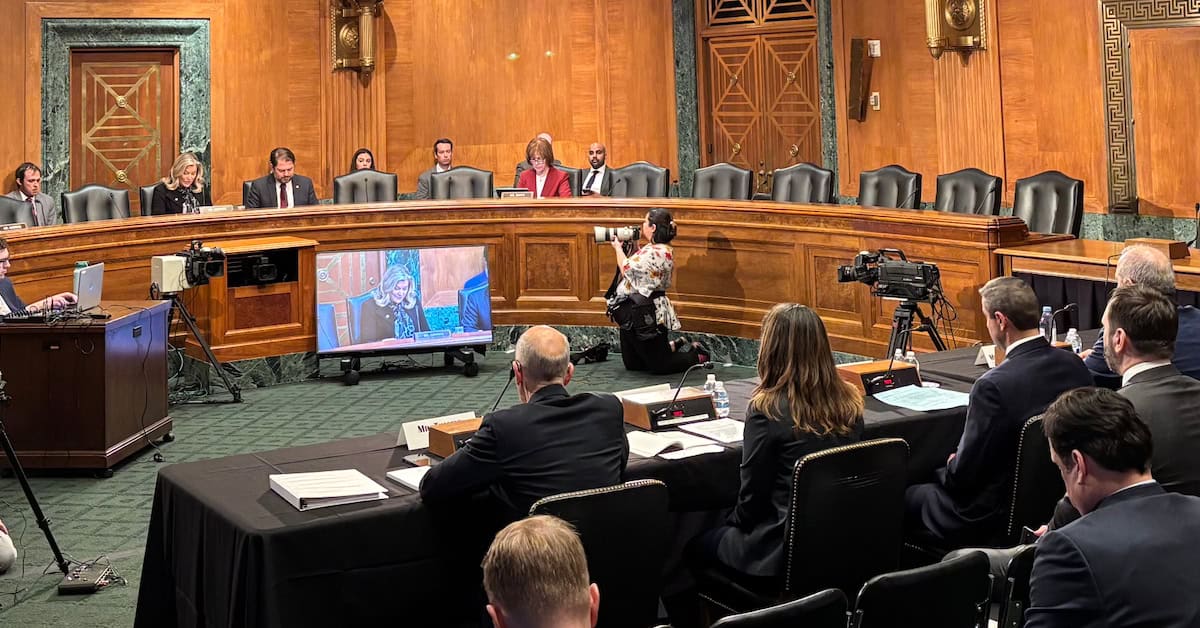
Today, the Senate Banking Subcommittee on Digital Assets hosted its first hearing, entitled “Exploring Bipartisan Legislative Frameworks for Digital Assets,” at which certain members of the subcommittee and crypto industry witnesses predominantly discussed stablecoin regulation.
Senator Cynthia Lummis (R-WY), a long-time proponent of the Bitcoin and digital asset industry, presided over the hearing with assistance from ranking member of the subcommittee, Senator Ruben Gallego (D-AZ).
The witnesses included Tim Massad, former CFTC Chair and Research Fellow at the Kennedy School of Government at Harvard University; Jai Massari, Chief Legal Officer at Lightspark; Jonathan Jachym, Global Head of Policy and Government Relations at Kraken; and Lewis Cohen, Partner at Cahill Gordon & Reindel LLP.
Setting the tone for the meeting, Senator Lummis stated that she intends to do her part in passing bipartisan legislation for Bitcoin and stablecoins. (This was one of the few times during the meeting that the word “Bitcoin” was mentioned. One of the only other times in the hearing it was mentioned was when Massad voiced that he’s objected to the creation of a Strategic Bitcoin Reserve.)
Throughout the hearing, Massad stressed the importance of monitoring stablecoin transactions. He suggested extending the “regulatory perimeter” to address AML (Anti-Money Laundering) challenges associated with stablecoins and even proposed that smart contracts be designed in a way that mitigates the risk of bad actors using them.
“[We might] program smart contracts so that transactions can’t go through unless someone has been properly vetted,” said Massad.
Massad also suggested that stablecoin issuers “aggressively monitor stablecoin activity” as a means to keep an eye out for AML violations.
Massari pointed out that authorities can also surveil stablecoin transactions, as these assets run on public blockchains. She also called for sensible regulation around the technology — so long as it isn’t too heavy-handed.
“We have a tendency [when regulating] financial services to take the new thing and cram it into the old,” she said.
What is more, she also advocated for a “common set of standards” to govern stablecoin issuers so that users can feel more confident in all stablecoins being properly backed.
Jachym made efforts to shift the focus of the hearing from stablecoins to the Digital Asset Market Structure bill, claiming that it was “critical” that regulatory agencies construct clear guidelines for which digital assets are securities and which aren’t.
He didn’t receive much uptake though. Massad stated that discussing stablecoins was more important than discussing the market structure bill, making the case that the market structure bill isn’t a pressing matter, as regulators can work with existing securities laws to regulate crypto markets.
Jachym stressed the point that “the jurisdictional lines [around] digital assets should be simple” and said that “the lack of regulatory certainty in the U.S. has impeded growth [in the crypto industry.]”
Cohen made a similar claim, stating that crypto entrepreneurs in the U.S. “feel the constant threat of litigation,” alluding to former SEC Chair Gary Gensler’s “regulation-by-enforcement” approach.
He also shared that the “uncertain regulatory environment has left both consumers and users of digital assets at risk.”
The only participant in the hearing who directly pushed back on the U.S. government’s desire to (over)regulate digital assets was Senator Bernie Moreno (R-OH).
“The government has this total and complete desire to control things,” said Senator Moreno, who went on to share that a number of recent technologies have been used for illicit purposes, not just crypto.
“Why all of a sudden when we got to digital currencies did we think here in Washington, D.C. that we are going to decide the pace of innovation?” he concluded.
Throughout the meeting, the subcommittee members asked the witnesses which jurisdictions around the world the U.S. should take cues from in modeling its digital asset regulatory framework.
Massad made the case for Europe and the Markets in Crypto-Assets Regulation (MiCA) framework, which the European Union just put into effect, while Jachym suggested looking to states like Wyoming, where Kraken is based, to learn from the crypto laws the state’s legislature has passed.
While the Senators on the subcommittee and the witnesses present offered various perspectives on the topics discussed, a certain sentiment permeated the hearing, which was that it’s high time politicians on both sides of the aisle come together to create clear rules of the road for the crypto industry.
“Bipartisan support for crypto policy is no longer a distant goal on the horizon,” said Jachym, with a certain sense of relief.