

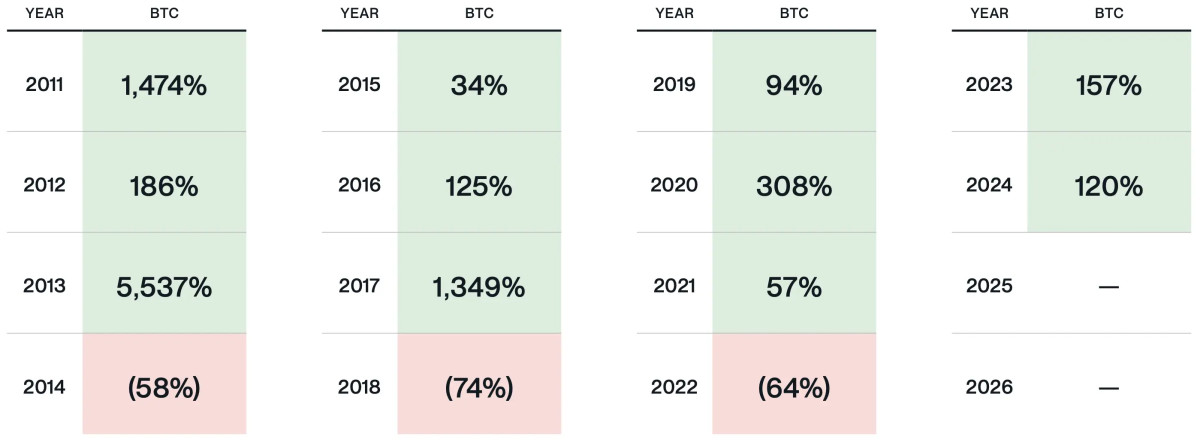
The Bitcoin market has long been defined by its seemingly immutable four-year cycle, a pattern of three years of surging prices followed by a sharp correction. However, a seismic shift in policy from Washington, led by former President Donald Trump, may shatter this cycle and usher in a new era of prolonged growth for the cryptocurrency industry.
Matt Hougan, Chief Investment Officer at Bitwise Asset Management, recently posed an intriguing question: Can Trump’s Executive Order break crypto’s four-year cycle? His answer, though nuanced, leans towards an emphatic yes.
The Four-Year Cycle: A Recap
Hougan clarifies his personal belief that the four-year Bitcoin market cycle is not driven by Bitcoin’s halving events. He states, “People try to link it to bitcoin’s quadrennial ‘halving,’ but those halvings are misaligned with the cycle, having occurred in 2016, 2020, and 2024.”
Bitcoin’s four-year cycle has been historically driven by a mix of investor sentiment, technological breakthroughs, and market dynamics. Typically, a bull run emerges following a significant catalyst—be it infrastructure improvements or institutional adoption—which attracts new capital and fuels speculation. Over time, leverage accumulates, excesses emerge, and a major event—such as regulatory crackdowns or financial fraud—triggers a brutal correction.
This pattern has played out repeatedly: from the early days of Mt. Gox’s implosion in 2014 to the ICO boom and bust of 2017-2018, and most recently, the deleveraging crisis of 2022 with the collapse of FTX and Three Arrows Capital. Yet, every winter has been followed by an even stronger resurgence, culminating in Bitcoin’s latest bull run spurred by the mainstream adoption of Bitcoin ETFs in 2024.
Related: Nasdaq Proposes In-Kind Redemptions for BlackRock’s Bitcoin ETF
The Executive Order: A Game Changer
The fundamental question Hougan explores is whether Trump’s recent Executive Order, which prioritizes the development of the digital asset ecosystem in the U.S., will disrupt the established cycle. The order, which outlines a clear regulatory framework and even envisions a national digital asset stockpile, represents the most bullish stance on Bitcoin from any sitting or former U.S. president.
The implications are profound:
- Regulatory Clarity: By eliminating legal uncertainty, the EO paves the way for institutional capital to flow into Bitcoin at an unprecedented scale.
- Wall Street Integration: With the SEC and financial regulators now pro-crypto, major banks can enter the space, offering Bitcoin custody, lending, and structured products to their clients.
- Government Adoption: The concept of a national digital asset stockpile hints at a future where the U.S. Treasury could hold Bitcoin as a reserve asset, solidifying its status as digital gold.
These developments will not play out overnight, but their cumulative effect could fundamentally alter Bitcoin’s market dynamics. Unlike previous cycles that were driven by speculative retail euphoria, this shift is underpinned by institutional adoption and regulatory endorsement—a far more stable foundation.
Related: Why Hundreds of Companies Will Buy Bitcoin in 2025
The End of Crypto Winters?
If history were to repeat itself, Bitcoin would continue its ascent through 2025 before facing a significant pullback in 2026. However, Hougan suggests this time may be different. While he acknowledges the risk of speculative excess and leverage-driven bubbles, he argues that the sheer scale of institutional adoption will prevent the kind of prolonged bear markets seen in the past.
This is a crucial distinction. In previous cycles, Bitcoin lacked a strong base of value-oriented investors. Today, with ETFs making it easier for pensions, hedge funds, and sovereign wealth funds to allocate to Bitcoin, the asset is no longer solely dependent on retail enthusiasm. The result? Corrections may still occur, but they will likely be shallower and shorter-lived.
What Comes Next?
Bitcoin has already crossed the $100,000 mark, and projections from industry leaders, including BlackRock CEO Larry Fink, suggest it could reach $700,000 in the coming years. If Trump’s policies accelerate institutional adoption, the typical four-year pattern could be replaced by a more traditional asset-class growth trajectory—akin to how gold responded to the end of the gold standard in the 1970s.
Related: BlackRock CEO Larry Fink Forecasts $700K Bitcoin Price Amid Inflation Worries
While risks remain—including unforeseen regulatory reversals and excessive leverage—the direction of travel is clear: Bitcoin is becoming a mainstream financial asset. If the four-year cycle was driven by Bitcoin’s infancy and speculative nature, its maturation may render such cycles obsolete.
Conclusion
For over a decade, investors have used the four-year cycle as a roadmap for Bitcoin’s market movements. But Trump’s Executive Order could be the defining moment that disrupts this pattern, replacing it with a more sustained and institutionally-driven growth phase. As Wall Street, corporations, and even governments increasingly embrace Bitcoin, the question is no longer if crypto winter will come in 2026—but rather if it will come at all.
Disclaimer: This article is intended for informational purposes only and does not constitute financial advice. Readers are encouraged to conduct thorough independent research before making investment decisions.